
📋 Quick summary
| Key works | Ludovisi Throne, Galatian Suicide, Ludovisi Ares, Great Sarcophagus |
| Recommended time | 90–120 minutes |
| Label language | Italian + English |
| Audio guide | € 5 (5 languages) |
| Photography | Permitted without flash |
Palazzo Altemps is not an encyclopaedic museum like Palazzo Massimo. It holds around 200 sculptures on display, but the density of masterpieces per square metre is exceptional. On this page you'll find the ten works that, after dozens of guided visits, we have identified as unmissable — the ones that alone justify the trip here.
1. The Ludovisi Throne (fifth century BC)
Room: Throne Room, piano nobile
Time: 10–15 minutes
Type: Greek marble high-relief, three carved sides
This is the work of the museum. Probably made at Locri Epizephyrii (in Magna Graecia, modern Calabria) around 460 BC, the Ludovisi Throne depicts — according to the most widely accepted interpretation — the birth of Aphrodite from the sea. The goddess rises nude from the water, supported by two attendants who partly cover her body with a wet veil. The perfection of the "wet drapery" — the garment clinging to the body, rippled, carved with a skill that still seems impossible — is a benchmark of Classical Greek sculpture.
On the two short sides of the throne are contrasting female figures: one nude, playing a double flute (interpreted as a hetaira, a courtesan), and one veiled, burning incense (the bride). The opposition between profane love and sacred love, sixteen hundred years before Titian.
👀 What to look for in the details
- The bend of the goddess's elbow on the edge of the throne — the one point where the marble seems almost to breathe
- The veil crossing the body: notice how the carving suggests two different layers of fabric
- The feet of the flute player: the "crossed" position was unusual for the period
2. The Galatian Suicide (Ludovisi group)
Room: Galatian Room, piano nobile
Time: 5–8 minutes
Type: Roman marble copy (second century AD) of a Greek bronze original of 230 BC
A Galatian warrior, defeated in battle, stabs himself in the chest after killing his wife to spare her from slavery. The original formed part of a monumental group commissioned by King Attalus I of Pergamon to commemorate his victory over the Galatians in the third century BC. The bronze is lost; a few Roman marble copies survive, and this is the finest.
Three things make it extraordinary: the torsion of the warrior's body (a continuous axis from the left forearm to the right leg), the soft collapse of the woman's body as she falls to the ground, and the expression on the Galatian's face — not heroic, not theatrical, but dignified. It is one of the high points of Hellenistic sculpture.
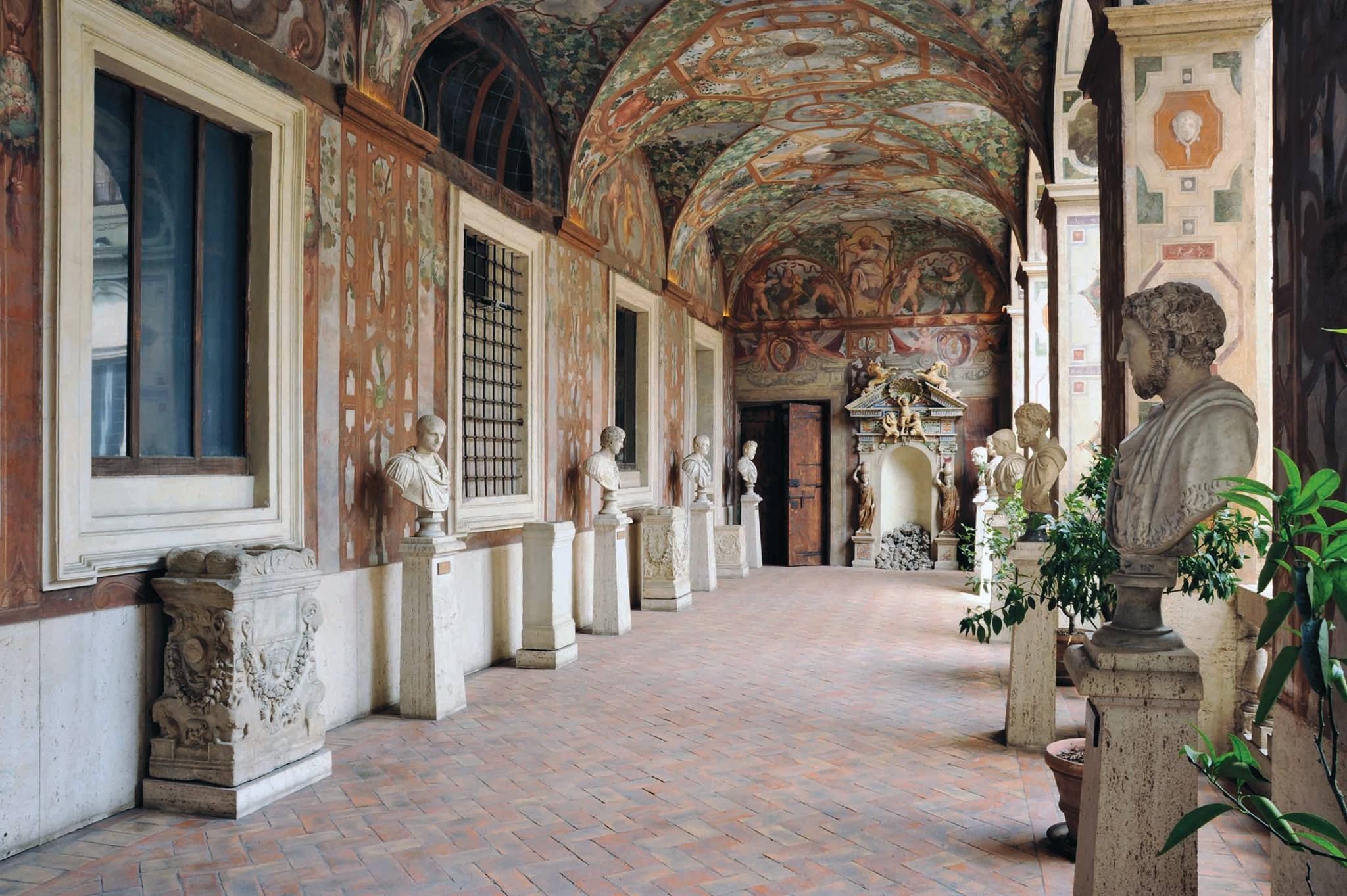
3. The Ludovisi Ares (with Bernini's restoration)
Room: Ludovisi Ares Room, piano nobile
Time: 7 minutes
Type: Roman copy of a Greek original, fourth century BC, restored by Gian Lorenzo Bernini in 1622
A quiet, almost melancholic statue: the god of war seated in repose, hands resting on the sword propped between his legs. At his feet a small Eros — read as an allusion to the love between Ares and Aphrodite — plays with the helmet.
The extraordinary historical interest lies in the restoration signed by Bernini: when Cardinal Ludovisi acquired the sculpture in 1622, young Gian Lorenzo (aged 24) was commissioned to fill in the missing sections. Bernini remade the sword hilt, part of the right foot and some details of the cloak. The additions are almost invisible to the naked eye, but a guide can point them out — and the effect is memorable: you are looking at a Classical work completed by one of the greatest sculptors in the history of art.
4. The Great Ludovisi Sarcophagus
Room: Sarcophagus Room, piano nobile
Time: 10 minutes
Type: Roman sarcophagus, marble, 250–260 AD
One of the most impressive sarcophagi in the ancient world. Standing 1.5 metres tall and 2.7 metres long, it is carved in high relief that approaches full round. The scene is a chaotic battle between Romans and barbarians, probably Goths: more than forty figures interlock in multiple planes of depth, with horses, shields, spears and fallen bodies.
At the centre, on horseback, the young patron — a Roman commander, most likely Herennius Etruscus, son of Emperor Decius — dominates the scene with a gesture of victory. On his forehead the letter X is carved (a Chi-Rho Christogram, or a solar victory symbol? Scholars still disagree).
📸 Photography tip
Photograph the sarcophagus in raking light: ask the gallery attendant whether you can move to the window side. Natural light entering at an angle brings out the depth of the modelling in a way that flash entirely destroys.
5. The Athena Parthenos
Room: Atlas room, ground floor
Time: 5 minutes
Type: small-scale Roman copy of Pheidias's chryselephantine statue (fifth century BC)
One of the very few surviving copies of Pheidias's Athena Parthenos — the colossal statue (12 metres of gold and ivory) that once dominated the Parthenon in Athens. The Palazzo Altemps copy stands just over a metre tall, but it is precious because — together with a handful of other examples scattered through the world's museums — it allows us to imagine the appearance of the lost original.
6. The Ludovisi Erinyes (youthful head)
Room: piano nobile
Time: 3–4 minutes
Type: colossal female head, marble, fifth century BC (Greek original)
One of the very few original Greek sculptures in the museum (not a Roman copy). A colossal female head, nearly 70 cm long, with a young and austere face. The identification is uncertain: perhaps one of the Furies, perhaps Hera. Seen in raking light, the surface of the marble still shows traces of original polychromy — pigment applied by Greek painters over two millennia ago.
7. Dionysus and Satyr
Room: piano nobile
Time: 4 minutes
Type: Roman copy of a Greek original, marble
The group shows the young god of wine leaning on the arm of an older satyr. The S-curve composition is typical of Hellenistic sculpture: two figures balancing in dynamic equilibrium, a pair of gazes that deliberately avoid each other. Also restored in the seventeenth century, with the hands and part of the thyrsus (Dionysus's ritual staff) replaced.
8. The Apollo Citharoedus
Room: ground floor
Time: 4 minutes
Type: Roman copy, marble, first–second century AD
Apollo is shown in long priestly robes, a cithara resting against his side. This is a "musical" Apollo, far from the athletic iconography most commonly associated with the god. The left leg is slightly bent, weight shifted to the right: the "contrapposto" stance typical of the Polykleitan tradition.
9. The Courtyard of Honour (architecture)
Space: main entrance
Time: 5–10 minutes
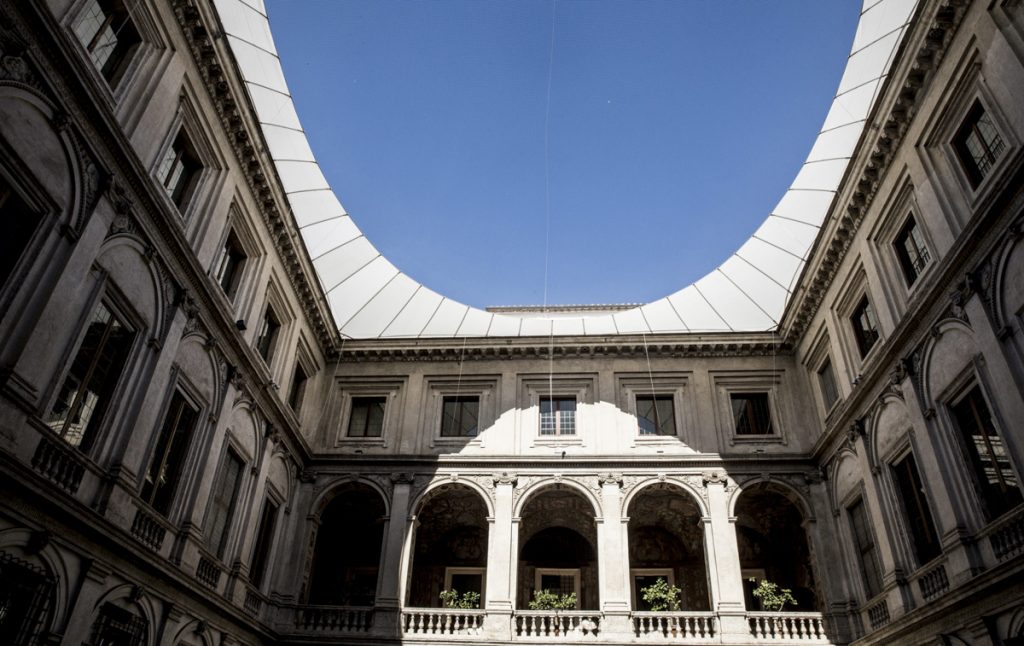
Not a carved work, but an architectural one that deserves full museum status. Three superimposed loggias, columns in the Vitruvian superimposed orders (Tuscan on the ground floor, Ionic on the first, Corinthian on the second), a commemorative Latin inscription at the centre. Morning light, filtered from the east, illuminates the columns spectacularly before 11:00.
10. The Chapel of Sant'Aniceto
Room: Altemps Apartment, piano nobile
Time: 8 minutes (if open)
Type: sixteenth-century private chapel
The Altemps family's private chapel, built in 1603 to house the relics of Pope Anicetus (second century AD), purchased by Cardinal Altemps. Frescoes by Pomarancio, gilded stucco, an altar in polychrome marbles. A small Baroque machine ante litteram, survived intact. It is not always open to the public — ask at the entrance whether guided visits are scheduled that day.
A plan to see all top 10
If you follow the recommended order (courtyard → ground floor → piano nobile → apartment), you can comfortably see all ten in 2 hours. Here's the timing:
| Time | What to do |
|---|---|
| 00:00 – 00:10 | Courtyard + ticket desk / entry |
| 00:10 – 00:30 | Ground floor (Athena Parthenos, Apollo Citharoedus) |
| 00:30 – 01:30 | Piano nobile (Throne, Galatian Suicide, Ares, Sarcophagus, Erinyes, Dionysus) |
| 01:30 – 02:00 | Altemps Apartment + Chapel of Sant'Aniceto |