
📋 What's in this guide
History of the palace in 5 minutes
To understand Palazzo Altemps you need to separate three overlapping time frames. First: the building itself. Started in 1477 by Girolamo Riario, nephew of Pope Sixtus IV, it was sold unfinished in 1568 to Cardinal Marco Sittico Altemps, a Bavarian prelate transplanted to Rome. It was Altemps who completed the structure as it stands today, hiring architect Martino Longhi the Elder for the piano nobile and commissioning artists including Ottaviano Mascherino and Antonio Viviani to fresco the interiors.
Second layer: the antiquities collection. The palace housed Roman sculptures as early as the sixteenth century, but the main core arrived much later, when the Italian state purchased the Boncompagni Ludovisi collection in 1901 for 1.4 million lire of the day. That collection — 104 Greek and Roman sculptures, many restored in the seventeenth century by Bernini and Algardi — was distributed across various sites and in 1997 finally settled here at Palazzo Altemps, after thirty years of building restoration.
Third layer: the museographical concept. Palazzo Altemps is not a "nineteenth-century museum" in the conventional sense of rooms, display cases and labels. It is an experiment in contemporary curation: the sculptures are placed in the palace's own rooms, often in front of windows, beside sixteenth-century fireplaces, beneath painted ceilings. The effect is that of a noble wunderkammer — as though the collection still lived the life it was assembled for.
💡 Why this matters for your visit
If you walk in expecting "another Roman sculpture museum", you may find it repetitive. If you walk in thinking of it as a sixteenth-century noble house populated by ancient masterpieces, the experience changes entirely. The second frame of mind is the right one.
The room-by-room route (optimised)
The museum is arranged over two main floors — ground floor and piano nobile — plus a few smaller rooms. The official route is self-guided, but over the years we have found an order that works best for first-time visitors. Here is the sequence we recommend.
1. The Courtyard (5 minutes)
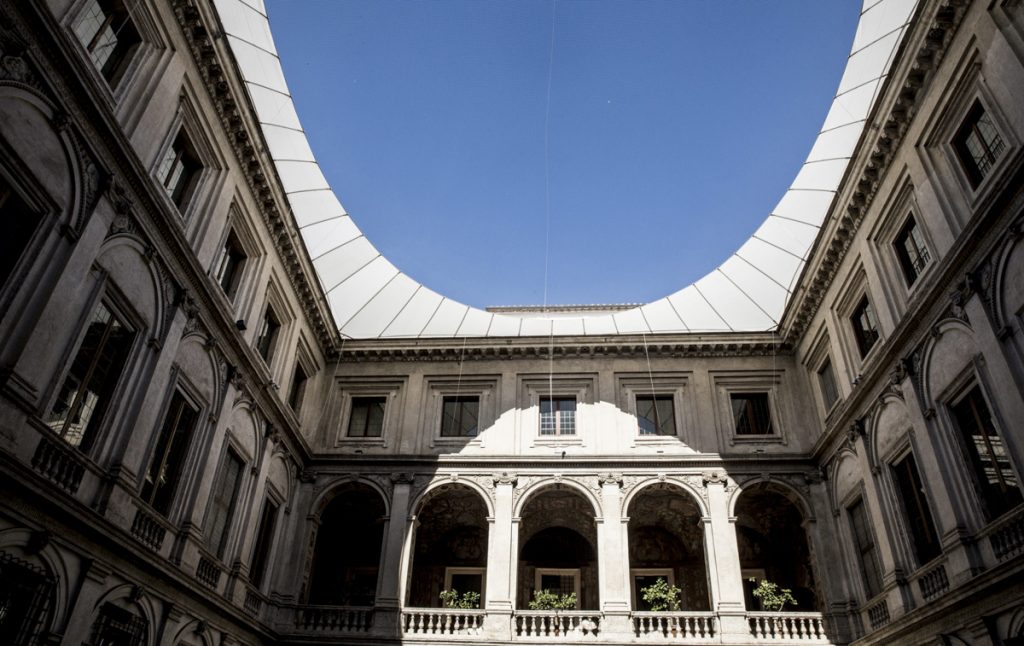
Immediately after the ticket desk. This is the building's first breath: three superimposed loggias, Renaissance proportions, a central basin with a Latin inscription dedicated to Cardinal Altemps. Take two minutes to look up at the loggias: you'll see that each floor has columns of a different order (Tuscan, Ionic, Corinthian) following Vitruvian canons. Best photo: from the centre of the courtyard looking up, backlit, before 11 in the morning.
2. Ground-floor rooms (20 minutes)
These house sculptures from various minor collections and excavation fragments. The Farnese Atlas room (actually a replica — the original is in Naples), the Herms Gallery, rooms dedicated to imperial busts. It's not the most spectacular section, but it calibrates your eye: note the quality of the marble, the difference between original heads and heads re-carved in the seventeenth century (usually distinguishable by their lighter colour and slightly glossier finish).
3. Up to the piano nobile (the key transition)
The sixteenth-century staircase is itself an artwork: broad landings, stucco panelling, coffered painted ceilings. Take it slowly. The piano nobile is where the museum truly begins.
4. The Ludovisi Rooms (40 minutes — the heart of the visit)
This is where the masterpieces are concentrated. In recommended order:
- Throne Room: spend at least 10 minutes here. Walk around the high relief, look from different angles, read the label (it's one of the best in the museum).
- Galatian Room: the Galatian Suicide group is striking. View it standing, at the right distance — about 3–4 metres away.
- Ludovisi Ares Room: look for Bernini's restorations. The sword hilt is a Baroque addition.
- Great Sarcophagus Room: the most emotionally charged. Romans versus barbarians, 1.5 metres of high relief. Demanding to decode but extraordinary.
5. The Altemps Apartment (20 minutes)
A section that is often overlooked. These are the family's private rooms: original frescoed ceilings, sculpted fireplaces, stucco friezes. Here the ancient collection thins out and the palace itself takes centre stage as an architectural work. The Hall of Painted Perspectives and the Chapel of Sant'Aniceto (restricted, but viewable on request) are the highlights.
6. The Egyptian section (15 minutes — optional)
A small collection of Egyptian artefacts and Isis-related finds from excavations in the Campus Martius, where the Iseo Campense once stood. If you're interested in Oriental cults in Rome, this is a real gem; otherwise you can skip it without regret.
How long does a visit actually take
Official guidance says "around an hour". That is an underestimate. Here are realistic timings by visitor profile:
| Visitor type | Duration | Notes |
|---|---|---|
| Quick visit (top 5 only) | 45–60 minutes | Highlights only, no lingering |
| Standard visit | 90–120 minutes | All main rooms, courtyard pause |
| With audio guide | 2–2.5 hours | Official audio guide is around 75 minutes net |
| Guided tour | 75–90 minutes | Focus on 15–20 selected works |
| In-depth visit | 3–4 hours | For art history enthusiasts |
🎯 Practical tip
If you're planning several museums in one day, budget a minimum of 90 real minutes for Palazzo Altemps, including entry checks and time for the toilets. This is not a museum to rush: the density of masterpieces per square metre is exceptionally high.
5 mistakes we see almost everyone make
1. Arriving without a ticket on Saturday afternoon
The museum never has colossal queues, but on Saturdays between 11:00 and 15:00 the ticket desk can mean a 20–30 minute wait. Entirely avoidable by booking online: you walk straight to the turnstile, show the QR code, and in you go.
2. Assuming it's suitable for young children
Under 10, it risks being boring. There are no interactive stations, videos or activity trails. It's an "adult" museum in the best sense of the word: contemplative, still, meant to be looked at slowly. Families with young children might consider Crypta Balbi (more archaeological, with visible excavations) or Palazzo Massimo (mosaics and frescoes with more immediate visual appeal).
3. Stopping on the ground floor
The most impressive section is the piano nobile. It sounds obvious, but many visitors leave after the first rooms convinced they've "seen everything". That accounts for just 30% of the collection. Head straight up to the piano nobile first, then come back to the ground floor if you have time.
4. Underestimating the audio guide
At € 5, this is one of the best audio guides we've tested in Rome. The wall labels are excellent but concise; the audio guide covers the seventeenth-century restorations, the changes of ownership, the behind-the-scenes stories. If it's your first visit, take it.
5. Not looking up
Almost everyone focuses on the sculptures and nothing else. But many ceilings are frescoed: grotesques, mythological scenes, portraits, heraldic crests. Glance up in every room — it's always worth it.
Practical facilities: toilets, cloakroom, café
Cloakroom
Free of charge, at the entrance on the right. Compulsory for large backpacks, umbrellas and small cases. You receive a numbered token — don't lose it, as bags will not be returned without it.
Toilets
Two locations: one on the ground floor (near the ticket desk), one on the piano nobile (near the exit of the Altemps Apartment). Both are accessible, clean and free.
Café
There is no café inside the museum. For a break, the neighbourhood is full of bars. We recommend Bar del Fico (3 minutes' walk), Caffè Sant'Eustachio (5 minutes — a historic Roman coffee institution) or Tre Scalini on Piazza Navona (touristy but convenient).
Bookshop
Small but well-curated, at the entrance. Museum catalogues, monographs on the Ludovisi collection, archaeology books, plaster reproductions. Prices are in line with other Italian museum shops.
Wi-Fi and digital access
Free Wi-Fi (network "MNR-Free", no password in some rooms). The Museo Nazionale Romano has a free app you can download before your visit, offering themed itineraries.
What to see nearby
One of Palazzo Altemps' greatest assets is its location. You are in the heart of the historic centre, a few minutes' walk from some of Rome's most famous sights. Here's how to build a fuller day around your visit.
Half-day itinerary
- 09:30 – Palazzo Altemps opens
- 11:30 – Coffee in Piazza Navona (1 minute away)
- 12:00 – Church of San Luigi dei Francesi (5 min) for the three Caravaggio paintings in the Contarelli Chapel
- 12:45 – Pantheon (8 min)
- 13:30 – Lunch in the lanes around Campo de' Fiori (10 min)
Full-day itinerary
Add in the afternoon: Piazza di Spagna, Trevi Fountain, and — if you have the energy — finish with an aperitivo at Castel Sant'Angelo at sunset. Three attractions, all walkable, no metro needed, and the route stays largely in the shade even in summer.